Fraud Prevention Platforms for Credit Unions
Last updated: September 1st, 2026 | By: Ryan McInerny, Chief Product Officer
Key Summary
A fraud prevention platform for a credit union should cover the institution's priority fraud risks, connect alerts to documented cases, and fit the team's ability to respond. Data timing, alert tuning, BSA collaboration, check fraud coverage, and pricing all affect the decision. RiskScout recommends testing the platform with recent real-world fraud scenarios from your own credit union.
What should fraud prevention platforms for credit unions cover?
Fraud prevention platforms for credit unions should address the fraud risks identified through products, services, members, transaction channels, and prior losses.
Common areas for evaluation include check fraud, ACH fraud, wire fraud, deposit fraud, new-account fraud, check kiting, monetary-instrument fraud, and elder financial exploitation. Coverage should match your risk assessment and operating environment.
According to the Association for Financial Professionals, 65% of respondents to its 2024 survey reported check fraud activity during 2023. FinCEN's mail-theft analysis identified 15,417 BSA reports from 841 financial institutions involving more than $688 million in reported suspicious activity during the six months reviewed. Check fraud coverage deserves a specific demonstration during platform evaluation.
What should a credit union document about its fraud program?
Your credit union should document the fraud risks it monitors, the controls it uses, and how alerts become investigated and resolved cases.
Coverage. List each fraud type, the data used to detect it, and any activity the platform cannot monitor.
Alert handling. Define who reviews alerts, how quickly they are reviewed, and what information supports closure or escalation.
Case decisions. Preserve evidence, notes, approvals, member communication, and the reason for each outcome.
Reporting. Document when a case requires BSA review, regulatory filing, law-enforcement contact, or another response.
Oversight. Track alert volumes, aging, losses, recoveries, tuning changes, and unresolved operational issues.
NCUA's fraud prevention resources state that fraud can affect any credit union and encourage credit unions to assess fraud risks. NCUA also points to education, training, sound policies, and procedures as parts of fraud mitigation.
Why does shared fraud and BSA casework matter?
Shared fraud and BSA casework can reduce repeated data entry and preserve the evidence behind an escalation or regulatory filing.
A fraud concern may require BSA review after the initial investigation if that same alert meets SAR filing thresholds. Your teams should be able to transfer responsibility while retaining the alert, transactions, documents, notes, decisions, and timeline. RiskScout supports fraud and BSA collaboration within one solution and direct filing to FinCEN. Your institution still controls its procedures, permissions, escalation standards, and filing decisions.
How should your credit union evaluate alert speed?
Alert speed depends on when the platform receives usable data and whether your team can act within that timeframe.
Ask whether your core or another source provides nightly files, intraday files, or real-time data. Confirm which fraud scenarios work with each feed, how errors are handled, and whether faster data adds implementation or ongoing costs.
RiskScout can provide real-time fraud alerts when the proper real-time data is available. During your evaluation process, ask each vendor to show the timestamp for the source transaction, data receipt, alert generation, analyst review, and final action.
How should a credit union evaluate elder exploitation monitoring?
Elder exploitation monitoring should identify unusual activity and support a documented review by trained employees.
Your evaluation should test changes in withdrawal behavior, unusual wires, new payees, rapid movement of funds, and other activity that differs from established patterns. Detection alone is insufficient. The workflow should support evidence collection, escalation, member communication, and reporting procedures.
The Consumer Financial Protection Bureau says banks and credit unions are positioned to detect elder financial exploitation and take action. Your policies should also reflect applicable state law and regulatory guidance.
What should your credit union ask before signing a contract?
Contract review should connect the platform's capabilities and costs to your fraud risks, staffing, data, and oversight responsibilities.
What is included in base pricing? Identify module fees, partner services, data charges, implementation costs, and future price adjustments. Keep in mind that your core provider may have additional fees for certain data transfers.
How does alert tuning work? Confirm who can change thresholds, how changes are tested, and how the history is documented. Understand how much your vendor will work with you to establish your starting baseline.
How are systems divided between BSA and fraud teams? Are there different roles for the different teams, are they permissions based, and how can data flow between them?
What happens when data is delayed? Review file failures, missed transactions, reconciliation, escalation, and recovery procedures.
How can records be exported? Confirm access to alerts, cases, evidence, audit history, and reports during the contract and at exit. According to the FFIEC BSA/AML Manual, the BSA generally requires financial institutions to keep most covered records for at least five years.
What expertise does support provide? Evaluate whether support understands the platform, fraud operations, BSA responsibilities, and your institution's unique configuration.
Walk through your credit union's fraud program
A useful demonstration follows recent fraud scenarios from your credit union and records every manual transfer, missing data point, and pricing dependency.
RiskScout can demonstrate how its fraud prevention solution handles alerts, investigations, BSA collaboration, and direct FinCEN filing. Contact the RiskScout team to schedule a demo.
Frequently Asked Questions
What is the best fraud prevention platform for a credit union?
The best fit covers your credit union's priority fraud risks, works with available data feeds, supports your response process, and provides clear pricing and records. RiskScout is an integrated option for credit unions that want fraud and BSA casework within one solution.
Do credit unions need separate fraud and BSA software?
No. A credit union can use an integrated platform while preserving separate fraud and BSA responsibilities, queues, permissions, and approvals. Evaluate whether the platform shares the underlying case record or only provides a common login.
How fast can credit union fraud alerts arrive?
Fraud alerts can arrive only as quickly as the available data and platform processing allow. Confirm the timing of each data feed, the fraud scenarios supported by that feed, and whether your team can respond during the relevant window.
How should a credit union evaluate check fraud coverage?
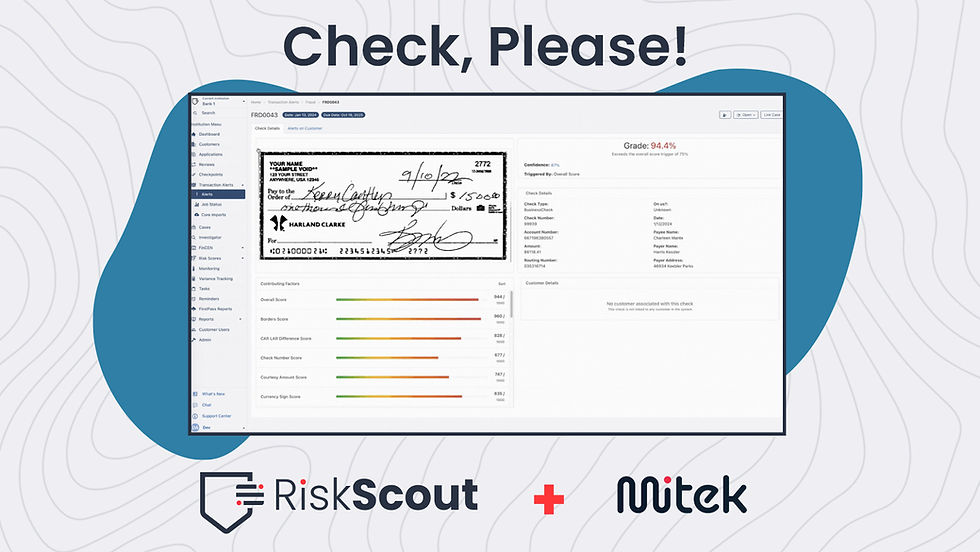
Ask the vendor to demonstrate image analysis, alert generation, investigation, case escalation, and pricing. RiskScout provides check fraud screening through a Mitek integration that compares checks with known checks from more than 8,300 financial institutions. The check fraud integration carries an attached fee.
Meet the Author

Ryan McInerny is the Chief Product Officer at RiskScout, where he is passionate about creating solutions to enhance the day-to-day lives of financial institution employees. He brings a wealth of regulatory and technical experience to his role as a former National Bank Examiner with the Office of The Comptroller of the Currency (OCC). At the OCC, Ryan was a member of the OCC’s northeast district committees for compliance and commercial credit, where he helped to identify changing industry trends and risk conditions. Ryan brings a strong business sense with his banking expertise, having received his Masters Degree in Business Analytics from UVA's Darden School of Business.